


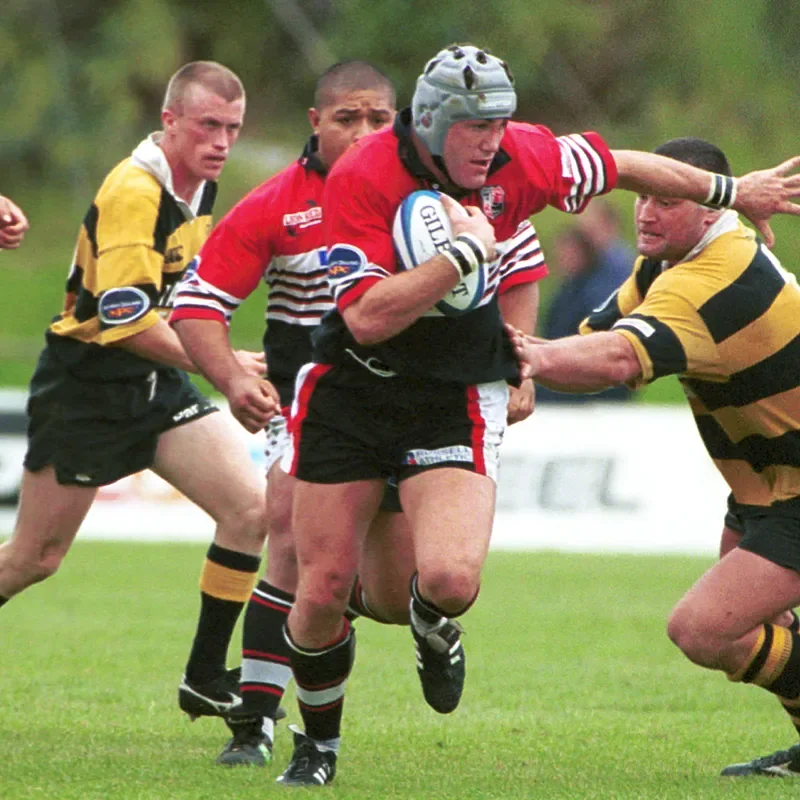
Glen Marsh
Kohd Heritage: WDUBPK
Glen Marsh’s rugby story starts where many Manurewa stories start: in a club environment that had to produce hard, useful rugby people rather than polished reputations. Manurewa’s own representative honours list records him among its Counties A representatives, its New Zealand Maori representatives, its New Zealand A representatives and its other international representatives through Japan. That matters because it places Marsh not as a passing professional name, but as part of the club’s visible pathway from local rugby into provincial, Super Rugby and international recognition.
By the mid-1990s Counties Manukau was building one of the most memorable sides in its provincial history. Marsh came into that era as a flanker, playing for Counties Manukau from 1996 to 2000. NPC50 records him as a Counties Manukau player across that full 1996-2000 window, with 40 total matches, 7 tries and 35 points across all matches, and 35 NPC championship matches within those figures. New Zealand Rugby History separately records his Counties Manukau provincial seasons from 1996 to 2000 and notes that he captained the province in 1999.
Those numbers sit inside a larger Counties revival. New Zealand History describes the 1996-97 Counties Manukau side as reaching successive NPC finals after leaner years, with a tough forward pack led by Errol Brain, Jim Coe, Glen Marsh and Junior Paramore. For a Manurewa player to be named in that company is significant. Marsh was part of the forward edge of a provincial team remembered for its force, resilience and refusal to play like an underdog, even when facing the established powers of New Zealand rugby.
His game carried beyond the province. New Zealand Rugby History lists Marsh with the Chiefs in 1998, 1999 and 2000, recording 30 Super Rugby games and 30 points. It also records him with New Zealand Maori in 1998, 1999 and 2000, and with New Zealand A in 1999. Manurewa’s honours page mirrors that wider recognition, naming him under New Zealand Maori, New Zealand A and Japan. The pattern is clear: Marsh’s Manurewa base led into a career that kept widening, without losing the local thread that made the achievement meaningful to the club.
The Japan chapter gives the story another dimension. Marsh later became connected with Japanese rugby and was selected in relation to Japan’s 2007 Rugby World Cup plans. The Japan Rugby Football Union later published that the International Rugby Board did not approve his eligibility for Japan, because of earlier New Zealand A involvement, and another player was selected in his place. The JRFU statement also made clear how highly Japan valued him at that point, describing the disappointment caused by losing a player whose physical play and conduct had influenced the national side.
For a Heritage story, that controversy should not be the whole point. It is part of the record, but the deeper story is simpler and stronger: Glen Marsh was a Manurewa player who became a Counties Manukau captain, a Chiefs flanker, a New Zealand Maori and New Zealand A representative, and a figure respected enough in Japan to be caught up in one of rugby’s difficult eligibility moments. His career shows how far a club pathway can travel, and how a player formed in local rugby can leave traces in provincial memory, professional rugby and the international game. For Manurewa, his name belongs on the wall because it connects the club’s everyday work to a much wider rugby map.
Sources
Published October 14, 2026